Birdfy Feeder 2 Pro Review
Backyard birdwatching often starts simple, but it quickly runs into limits. You miss rare species, forget names, and never quite capture the moment. This Birdfy Feeder 2 Pro review looks at how smart hardware and AI turn a passive hobby into an interactive, data-driven experience.
The Birdfy Feeder 2 Pro sits in a growing category of smart wildlife tech. It targets homeowners, creators, and curious beginners who want more than a traditional feeder. This review breaks down its cameras, AI system, solar setup, and real-world usability without hype.


Last update on 2026-09-23 / Affiliate links / Images from Amazon Product Advertising API
Design, Build, and Outdoor Readiness
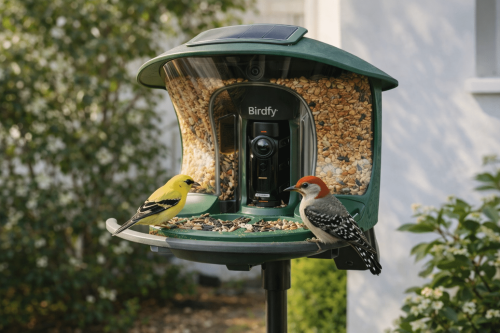
At first glance, the Birdfy Feeder 2 Pro looks familiar. It keeps the classic feeder silhouette. That matters because birds respond better to known shapes. However, the build feels far more deliberate than a standard plastic feeder.
The housing uses weather-resistant materials designed for year-round exposure. In practice, this means it handles rain, dust, and temperature swings without constant maintenance. The structure feels sturdy, not decorative.
The feeding tray sits wide and accessible. Birds can land comfortably without crowding. That improves capture rates for the camera system. It also reduces aggressive behavior between species.
Where this gets interesting is the integration of tech into the frame. The cameras sit cleanly within the housing. Nothing protrudes awkwardly. As a result, the feeder keeps a natural look instead of feeling like a gadget bolted onto your yard.
Mounting options include pole, wall, and tree setups. That flexibility matters because placement directly affects bird traffic and camera performance.
Dual Camera System Explained
The core upgrade in this Birdfy Feeder 2 Pro review comes from its dual camera setup. Most smart feeders use a single lens. Birdfy takes a different approach.
You get:
A front-facing camera focused on bird identification
A side or wide-angle camera capturing approach and behavior
This separation changes the experience. The front camera delivers sharp close-ups. It captures feather patterns, beak shape, and color detail. Those elements feed directly into AI recognition.
The secondary camera adds context. You see how birds land, interact, and move. For creators or enthusiasts, this adds storytelling value.
Video quality typically supports HD resolution. That ensures clear playback on phones and tablets. More importantly, it allows the AI to process visual data accurately.
Night vision also plays a role. Infrared support means the feeder stays active after sunset. While bird activity drops at night, this still captures unexpected visits.
In practice, the dual-camera system feels less like surveillance and more like observation.
AI Bird Recognition and Smart Features
The defining feature in this Birdfy Feeder 2 Pro review is its AI-powered bird recognition.
The system analyzes captured images and compares them to a bird database. It identifies species automatically and logs them in the app.
That matters because manual identification creates friction. Most users stop tracking after a few days. AI removes that barrier entirely.
The system typically includes:
Real-time species detection
Automatic photo and video capture
Event notifications when birds arrive
A digital bird journal inside the app
For example, you might receive a notification that a Northern Cardinal visited at 8:12 AM. You can open the app and view both camera angles instantly.
Accuracy depends on lighting, angle, and region. In strong daylight, results tend to be reliable. In lower light, the system may take longer or suggest similar species.
Over time, the system improves through updates. That gives the feeder a longer lifespan than traditional hardware.
App Experience and User Interface
Hardware only works if the software supports it. In this Birdfy Feeder 2 Pro review, the app plays a central role.

Setup follows a typical smart device flow. You connect the feeder to Wi-Fi, pair it with your phone, and configure notifications. The process usually takes under 15 minutes.
The interface focuses on clarity. You see:
Live camera feeds
Recorded clips
AI-identified species
Activity history
In practice, this layout works well for daily use. You do not need to dig through menus to find key information.
Notifications feel useful rather than intrusive. You can adjust sensitivity based on how active your yard is. For example, you might limit alerts during peak hours to avoid constant pings.
Cloud storage often comes into play here. Some features may require a subscription for extended video history or advanced AI insights. That is common in this category.
Solar Charging and Power Management
Power remains one of the biggest challenges for outdoor smart devices. This Birdfy Feeder 2 Pro review highlights its solar integration as a major advantage.
The feeder pairs with a solar panel that continuously recharges the internal battery. That reduces the need for manual charging.
In practice, performance depends on placement. Direct sunlight delivers consistent power. Shaded areas may require occasional charging through a cable.
Battery life varies based on:
Recording frequency
Notification settings
Weather conditions
Wi-Fi signal strength
Under balanced use, the system can run for extended periods without intervention. That makes it suitable for users who prefer a set-it-and-forget-it setup.
The trade-off comes in winter or low-light regions. Solar efficiency drops, so you may need to monitor battery levels more closely.
Connectivity and Smart Home Integration
The Birdfy Feeder 2 Pro relies on Wi-Fi for real-time features. A stable connection ensures smooth video streaming and accurate notifications.
In this Birdfy Feeder 2 Pro review, connectivity proves reliable in most suburban environments. However, placement matters. If the feeder sits far from your router, signal strength may drop.
Some users may consider adding a Wi-Fi extender for better coverage.
As for ecosystem integration, the feeder primarily operates within its own app. It does not heavily integrate with broader smart home platforms. That keeps the experience focused but limits automation options.
For most users, this is not a major issue. The core value comes from bird tracking rather than home automation.

Real-World Performance and Daily Use
Specifications only tell part of the story. This Birdfy Feeder 2 Pro review focuses heavily on real-world use.
Once installed, the feeder quickly becomes part of your daily routine. You check notifications during breaks, review clips in the evening, and you start recognizing patterns in bird visits.
For families, it adds an educational layer. Kids can learn species names without memorization. The app turns birdwatching into an interactive activity.
For creators, the dual-camera setup provides usable content. Short clips work well for social media. The framing feels intentional, not accidental.
Weather resilience also stands out. The feeder continues operating through rain and moderate wind without issue.
The only friction tends to come from:
Occasional false alerts from movement
AI misidentification in poor lighting
Dependency on Wi-Fi strength
These issues remain manageable and do not break the experience.
How It Compares to Alternatives
This Birdfy Feeder 2 Pro review would be incomplete without context.
Standard Birdfy Feeder (non-Pro):
The base model offers similar AI features but lacks the dual-camera system. It suits casual users who want identification without advanced capture.
Netvue Birdfy Lite models:
These often reduce cost by limiting features like solar support or camera quality. They work well for budget buyers but feel less complete.
Traditional camera feeders:
These rely on motion detection and manual review. They cost less upfront but require more effort. They also lack AI identification entirely.
In practice, the Pro version positions itself as a premium, all-in-one solution. You pay more, but you reduce friction across every step.
Ideal Use Cases
The Birdfy Feeder 2 Pro works best for users who want more than occasional bird sightings.
It fits:
Homeowners building a smart backyard setup
Families looking for educational tools
Content creators capturing wildlife moments
Remote workers who want passive engagement during the day
It also suits users who value automation. The AI system removes the need for manual tracking.
Things to Consider
The Birdfy Feeder 2 Pro review would not be complete without a clear look at trade-offs.
The price sits higher than standard feeders. That reflects the camera system and AI features.
Cloud features may require a subscription. Buyers should factor this into long-term cost.
Wi-Fi dependency means performance ties directly to network quality. Rural users may need additional setup.
Solar charging works best in consistent sunlight. Shaded yards may reduce efficiency.
None of these issues break the product. However, they shape who will benefit most.
Final Decision
The Birdfy Feeder 2 Pro delivers a clear upgrade over traditional birdwatching. It combines hardware, AI, and software into a system that feels cohesive.
In this Birdfy Feeder 2 Pro review, the dual-camera setup and AI recognition stand out as the defining features. They transform passive observation into active engagement.
This is not just a feeder. It is a smart observation tool for your backyard.
For users who want deeper insight, consistent capture, and a more interactive experience, it justifies its premium position.
Affiliate Disclosure
GadgetGram may earn a small commission if you purchase through links on this page. This helps support our independent testing and editorial work. We only recommend products we’ve researched or tested ourselves, and our opinions remain unbiased regardless of affiliate relationships.