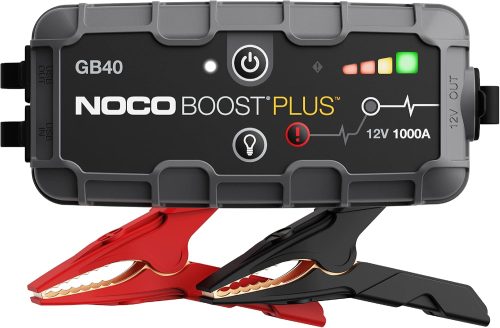
NOCO Boost GB40 UltraSafe Jumpstarter Review
A dead battery usually hits at the worst possible time. It happens before work, after a flight, or in bad weather when waiting for roadside help feels like a bad plan. That is why a product like the NOCO Boost GB40 review deserves a closer look. It promises enough power to start a dead 12V battery in seconds, while staying small enough to live in a glove box or trunk without becoming another bulky tool you forget about.
The GB40 sits in a sweet spot of the jump starter market. It is not the biggest pack you can buy, and it does not try to be. Instead, NOCO positions it as a compact 1000A lithium jump starter for cars, motorcycles, small trucks, boats, and similar 12V vehicles with engines up to 6.0L gas and 3.0L diesel. At about $99.95 direct from NOCO, it targets drivers who want real emergency coverage without stepping into heavier, pricier units meant for larger trucks or frequent shop use.

Last update on 2026-09-15 / Affiliate links / Images from Amazon Product Advertising API
Why the NOCO Boost GB40 still matters
The strongest argument for the GB40 is simple. It focuses on the exact problem most drivers want solved: get the vehicle started fast, safely, and without needing another car. NOCO rates it at 1000 amps, claims up to 20 jump starts per charge, and builds it for 12V lead-acid batteries only. That last point matters because it keeps expectations realistic. This is not a universal battery rescue box for every chemistry or every vehicle class. It is a focused emergency tool.
In practice, that focus helps the product age well. Many jump starters chase feature creep. They add air compressors, oversized housings, or gimmicky displays that make storage harder and reliability harder to judge. The GB40 stays narrow. You get jump-starting, device charging, a flashlight, and a compact body. For most commuters, students, consultants, and families with one or two cars, that is the smarter mix.
NOCO Boost GB40 design and build quality
The first thing the NOCO Boost GB40 review has to acknowledge is size. NOCO lists the unit at 2.4 pounds with dimensions of 6.7 x 3.2 x 1.7 inches in the manual, while Amazon’s retail listing presents a broader package dimension set. The real takeaway is that the jump pack itself is compact enough to store easily in a vehicle instead of living on a garage shelf. That changes behavior. A jump starter only helps if it is actually with you when the battery dies.
The enclosure also looks better engineered than many low-cost alternatives. NOCO gives the GB40 an IP65-rated housing with rubberized over-molding. That means better resistance to dust, splashes, and the normal abuse of trunk life. It also reduces the chance of scratching nearby surfaces. This is not military-grade equipment, but it is tougher than the average bargain-bin booster pack.
Here is where it stands out. The layout remains easy to understand even if you only use it once a year. The power button, charge indicators, boost light, error light, and manual override all follow a clear logic. That matters because battery emergencies are stressful. Gear that needs a tutorial every time loses value fast. NOCO’s interface keeps the learning curve low.
How the NOCO Boost GB40 performs in real use
On paper, the GB40 offers enough starting power for most mainstream vehicles. NOCO rates it for gas engines up to 6.0 liters and diesel engines up to 3.0 liters. For many sedans, compact SUVs, crossovers, motorcycles, and light-duty vehicles, that covers the real-world use case. If you drive a Honda Accord, Toyota RAV4, Subaru Outback, Ford Escape, or similar vehicle, the GB40 fits the job much better than oversized jump packs built for heavy trucks.
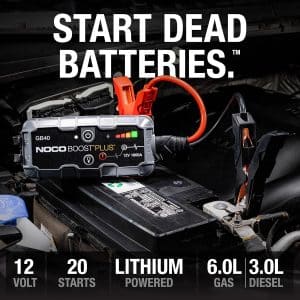
The “up to 20 starts per charge” claim needs context. It does not mean 20 hard starts on a large engine in freezing weather under every condition. It means the pack has enough reserve for multiple jump attempts across lighter and moderate-duty use. For buyers, that translates into confidence during long periods between charges, especially if the unit sits in the trunk as emergency insurance.
NOCO also states that the GB40 can work in ambient temperatures from -20°C to 50°C. That wide operating range matters for drivers in cold winter states and hot summer climates. Many emergency tools sound good in a product listing but become unreliable when they spend months inside a car. The GB40’s design aims directly at that use case.
Real-world usability looks strong too. The manual says most vehicles will start immediately, though some may need the GB40 connected for up to 30 seconds. It also warns against more than five consecutive jump starts within a 15-minute period, followed by a 15-minute rest. That guidance gives the product more credibility. NOCO does not pretend physics disappears. It tells you where the practical limits begin.
For commuting and family use, this matters more than raw headline amperage. A jump starter does not need to win a spec contest. It needs to start your car in a parking lot, at the office, in a driveway, or on the shoulder when you need help fast. The GB40 appears designed around that exact moment.
Safety, battery limits, and what buyers should know
Safety is the GB40’s biggest selling point. NOCO builds in spark-proof connections and reverse polarity protection, which lowers the risk of mistakes during setup. That is a major advantage for buyers who do not work on cars often. A jump starter should reduce panic, not add to it.
That said, buyers need to understand the boundaries. The GB40 works with 12V lead-acid batteries only. It is not meant for every battery chemistry, and the manual explicitly warns against jump-starting damaged or frozen batteries. NOCO also says the device will normally detect batteries down to 2 volts. Below that, users can enter Manual Override mode, but that disables the spark-proof and reverse polarity protections.
The trade-off is important. The manual override can rescue a battery that is too deeply discharged for automatic detection, but it turns this beginner-friendly tool into something that requires real attention. That does not make the GB40 unsafe. It means advanced capability comes with advanced responsibility. For most owners, the best experience will stay within the standard protected mode.
NOCO also includes a one-year limited warranty and packs the unit with heavy-duty clamps, a USB charging cable, and a microfiber storage bag. That bundle feels practical, though some buyers may still want a dedicated hard case for long-term trunk storage. NOCO sells one separately.
Charging, flashlight, and everyday utility
A strong NOCO Boost GB40 review should not ignore the extra features, because they add real value without turning the product into a bloated gadget. The USB function lets the GB40 recharge personal devices, with NOCO claiming up to four smartphone recharges. That is useful on road trips, in power outages, and during long days away from an outlet.

The recharge time also looks reasonable. NOCO says the pack can recharge in about three hours at 2.1 amps through USB. That is not cutting-edge fast by 2026 standards, but it is quick enough for a device you only top up occasionally. More importantly, it is easy. Most users can recharge it from common USB power sources without hunting for proprietary accessories.
The flashlight is another feature that sounds minor until you need it. The GB40 includes a 100-lumen LED with seven modes, including SOS and strobe. That will not replace a dedicated high-output work light, but it is enough to inspect battery terminals, change a tire, or make your vehicle more visible in a roadside emergency. In practice, that is exactly the kind of utility feature a jump starter should include.
One limitation stands out here, though. The GB40 still uses an older USB charging setup in its current documentation rather than the newer high-speed USB-C ecosystem buyers now expect across many premium gadgets. It works, but it does make the product feel more traditional than some newer rivals.
NOCO Boost GB40 vs the main alternatives
The most obvious step up is the NOCO GB50. It raises output to 1500A, supports engines up to 7.0L gas and 4.5L diesel, claims up to 30 jump starts, and sells for about $149.95 direct from NOCO. If you drive a larger SUV, a truck, or a diesel vehicle closer to the GB40’s ceiling, the GB50 makes more sense. For smaller daily drivers, the GB40 remains the better value and easier carry.
The HULKMAN Alpha 85 plays a different game. It pushes up to 2000A, supports engines up to 8.5L gas and 6.0L diesel, and adds a larger information display plus a 24-month warranty. It also costs far more, with recent listings around $163.93 to $199.90 depending on seller and bundle. That makes it attractive for buyers who want more headroom and more modern presentation, but it is harder to justify for a standard commuter car.
TOPDON’s JumpSurge1200 sits closer to the GB40 in mission. It offers 1200 peak amps, support for up to 6.5L gas and 4.0L diesel, and about 25 starts per charge. On paper, that gives it a slight edge in engine coverage while staying compact. Still, NOCO’s simpler reputation, clearer safety positioning, and strong market presence help the GB40 remain the more confidence-inspiring choice for mainstream buyers.
The Clore Jump-N-Carry JNC325 moves toward professional use. It emphasizes 450 start assist amps, UL2743 compliance, USB outputs, and shop-friendly utility, but recent retail pricing around $164 to $180 places it well above the GB40. That makes Clore more appealing for people who want a tougher workshop companion, while the GB40 stays better suited to everyday drivers who care most about portability and ease.
Who should buy the NOCO Boost GB40
The GB40 fits drivers who want a no-drama emergency solution. It makes sense for commuters, students, families, remote workers, and travelers who keep older batteries a bit too long and want backup before that becomes a problem. The NOCO Boost also suits small business owners who keep light-duty fleet vehicles on the road and want a safe, compact jump pack in each car without overspending.
It is also a smart pick for people who do not feel confident around car batteries. The spark-proof and reverse polarity protections reduce the fear factor. That changes the buying decision. Many shoppers do not need the most powerful pack. They need the one they will actually trust enough to use.
Things to consider are straightforward. Buyers with bigger trucks, heavier diesel needs, or repeated jump-start demands should move up to a stronger unit. Buyers who want the latest charging standard and more modern interface touches may find the GB40 a little dated. And buyers should remember that manual override exists for rare deep-discharge cases, not for casual use.
Final verdict on the NOCO Boost GB40
This NOCO Boost GB40 review comes down to fit. The GB40 does not try to be the biggest or most feature-packed jump starter in the category. It aims to be the one that makes sense for the largest number of drivers. In that role, it still performs very well. It offers strong starting power for mainstream vehicles, proven safety features, solid environmental durability, useful device charging, and a compact size that encourages you to keep it in the car all year.
That matters because emergency gear succeeds on trust. The GB40 feels like a product built around predictable, repeatable utility instead of inflated marketing. At roughly $99.95, it hits an appealing middle ground between cheap no-name packs and larger premium boosters that many drivers simply do not need. For most everyday cars and light-duty vehicles, the NOCO Boost GB40 review ends with a clear verdict: this remains one of the smartest compact jump starters you can keep in your trunk.
Affiliate Disclosure
GadgetGram may earn a small commission if you purchase through links on this page. This helps support our independent testing and editorial work. We only recommend products we’ve researched or tested ourselves, and our opinions remain unbiased regardless of affiliate relationships.