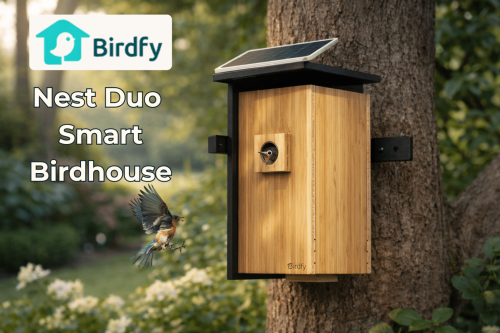
Birdfy Nest Duo Smart Birdhouse Review
Most birdwatching gadgets show you quick feeder visits, then move on. A true Birdfy Nest Duo Smart Birdhouse review matters because nesting tells the deeper story. You see courtship, nest building, egg laying, feeding, fledging, and the quiet gaps between those moments. That experience demands better camera placement, better power management, and better bird-safe design than a basic outdoor camera can offer.
The Birdfy Nest Duo sits at the premium end of the smart birdhouse category. It targets backyard birders, families, educators, and creators who want more than occasional clips. It gives you two 1080p cameras, a bamboo housing, solar charging, remote camera controls, AI behavior tracking, and app-based alerts in one package. At Birdfy’s official store, it lists at $279.99 as of March 27, 2026, while Best Buy shows the same model at $349.99. That price spread alone makes buying strategy part of the value equation.


Last update on 2026-09-23 / Affiliate links / Images from Amazon Product Advertising API
Why the Birdfy Nest Duo review matters
A smart birdhouse succeeds or fails on one question. Does it let you observe nest life without making birds feel watched? Birdfy clearly designed the Nest Duo around that problem. The company moved the main control points to the exterior camera and includes a 10-foot remote controller cable, so you can manage power and settings from a distance instead of opening the house and interrupting nesting behavior. That matters because the best feature in this category often comes from what the product helps you avoid.
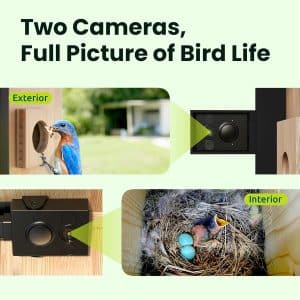
This product also solves a viewing problem that single-camera birdhouses cannot fully solve. One camera sits inside the house to capture eggs, hatchlings, and feeding behavior. The second camera watches exterior arrivals and departures. In practice, that gives the Birdfy Nest Duo a much fuller story arc than a one-camera model. You do not just see that chicks got fed. You see the parent bird approach, pause, enter, and leave. That sequence creates context, and context makes the footage more meaningful.
Here is where the Birdfy Nest Duo review gets interesting. Birdfy does not market this only as a camera in a box. It sells a documentary-style experience through its Story feature, AI bird behavior recognition, milestone alerts, and cloud clip handling. Some of that language sounds like marketing, but the underlying feature set points to a real use case. Busy owners do not want to scrub through hours of footage to find one egg-laying event or one feeding burst. Automation matters in a product that people may check during work, travel, or school hours.
Design, build, and bird-safe hardware
The Nest Duo uses bamboo and ABS, with Birdfy also describing the bamboo housing as FSC-certified and rot-resistant on its product page. Amazon lists the main material as bamboo, and Birdfy’s own spec sheet lists bamboo plus ABS. That combination makes sense. Bamboo gives the house a warmer, more natural look in a yard, while ABS likely handles some of the camera and hardware enclosure duties where weather resistance matters more than visual charm.
Size also matters more than most buyers expect. Birdfy lists the product at about 10 by 7.8 by 15.7 inches, with weight around 7.5 pounds. That makes the unit substantial enough to feel stable once mounted, but it also means installation needs some planning. This is not a tiny decor piece you hang anywhere on a whim. You need a proper mounting spot, decent access to sunlight for the panel, and a location that makes sense for the target species in your area.
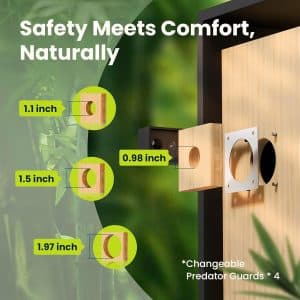
Bird safety stands out as one of the strongest parts of this design. The Nest Duo ships with four interchangeable entrance sizes, each paired with metal predator guards. Birdfy lists those entrance sizes at roughly 0.9, 1.1, 1.5, and 2.0 inches. That range helps owners tailor the house for different cavity nesters instead of hoping one generic opening works for every yard. Birdfy also mentions fledgling-friendly kerfs and proper ventilation, which matters because a birdhouse needs to function as a habitat first and a camera platform second.
The trade-off comes from the same premium build choices that help the product stand out. At 7.5 pounds, with two cameras and a solar setup, the Nest Duo asks more from the buyer than a simple wooden nest box. You need to think about placement, Wi-Fi reach, access for seasonal cleaning, and whether your chosen spot gets enough sun. Buyers who want a fast weekend install with almost no setup friction may prefer a simpler birdhouse. Serious backyard watchers will likely accept the extra work.
Birdfy Nest Duo review: cameras, AI, and real-world footage
The headline camera spec looks modest on paper. Birdfy uses dual 2MP cameras with 1080p video. In a market where 2K and 3MP labels appear everywhere, that may not sound exciting. In practice, 1080p can still work very well in a birdhouse because the camera sits close to the subject. The more important factor becomes lens tuning, placement, lighting control, and whether the footage stays usable in the dim interior of a nest box. Birdfy supports that with infrared and white-light night vision modes.
That matters because birdhouse footage creates a different challenge than feeder footage. Feeders happen in open light. Nest boxes often stay shaded, enclosed, and visually cluttered with twigs, feathers, and movement at very close range. A well-placed 1080p camera can beat a higher-resolution sensor with weaker tuning. Birdfy clearly understands this use case better than brands that mainly adapt general outdoor cameras to birding. The Nest Duo feels purpose-built around nesting behavior rather than broad wildlife monitoring.
The AI layer adds more practical value than the raw resolution figure. Birdfy says the Nest Duo can identify bird behaviors, send alerts for key stages like egg laying and brooding, and auto-edit story-style highlight clips. The company also lists AI bird behavior recognition as lifetime free. That does not guarantee perfect accuracy in every yard, but it does change how owners use the footage. Instead of opening the app just to check for movement, you can let the system surface meaningful events. For families, teachers, and content creators, that reduces friction in a big way.
On the other hand, buyers should notice one important omission. Birdfy lists two-way audio as not available on the Nest Duo. I do not see that as a major loss here. In fact, for a nesting product, that may even be the right call. Most users should not want an audio talkback feature inside an active birdhouse. Still, shoppers comparing spec sheets may notice that some cheaper rivals advertise two-way audio, such as Campark’s BH10. Birdfy chose bird-first restraint over checklist stuffing.
App experience, alerts, and sharing
A product like this lives or dies by its app. Birdfy supports 2.4GHz Wi-Fi, Bluetooth pairing, remote live viewing, and automatic recordings through the Birdfy app. The 2.4GHz limit may look old-fashioned, but it makes sense outdoors because 2.4GHz usually reaches farther and handles walls and yard distance better than 5GHz. For sheds, fences, poles, and tree-adjacent mounting points, range often matters more than raw network speed.
Birdfy also leans hard into sharing. The company says owners can share access with more than 20 accounts, which opens up strong real-world use cases. A family can follow a nesting cycle together. A grandparent can watch from another state. A classroom can monitor seasonal changes without crowding around one phone. A creator can use the birdhouse as a steady background story instead of chasing random wildlife clips. That broader sharing layer gives the Nest Duo more staying power than a gadget that only one person checks alone.

Cloud handling looks generous, but buyers need to read the details. Birdfy advertises unlimited free cloud storage for the duration of the current nesting story, then says you have 30 days to download videos after the story ends before deletion. That setup works well for active seasonal tracking, but it does not replace a permanent personal archive unless you actually export your favorite clips. In practice, organized users will do fine. Casual buyers who assume every video stays in the cloud forever may feel surprised later.
Battery life, solar charging, and outdoor reliability
Birdfy pairs a 9,000mAh rechargeable lithium-ion battery with a 5W solar panel. That gives the Nest Duo a stronger power story than several lower-tier birdhouse cameras. Birdfy also notes that the new Nest Duo upgraded to a 5W panel from an earlier 3W configuration. For a device meant to stay in place through a long nesting cycle, that matters because frequent manual charging undermines the entire point of remote observation.
Weather protection looks appropriately serious for the camera portion. Birdfy lists the cameras at IP66, with an operating range from 14°F to 113°F and humidity support from 0% to 90%. Those figures should cover most temperate outdoor setups across much of the United States, especially through spring and early summer when nest activity peaks. That said, buyers in very hot or very cold climates still need realistic expectations. Electronics inside wildlife gear always face more stress than plain wood boxes do.
Where this gets interesting is the balance between solar convenience and placement flexibility. The best bird placement does not always match the best solar exposure. A beautifully shaded nesting location may limit panel output. A bright sunny location may not attract the species you want. The Nest Duo gives you enough battery capacity to buffer some of that mismatch, but it cannot erase it. Thoughtful placement still matters more than the marketing promise of “set and forget.”
Birdfy Nest Duo review: where it beats rivals and where it does not
Against the standard Birdfy Nest, the Nest Duo wins on story depth. The regular Nest costs $149.99 on Birdfy’s site and gives you one 1080p 2MP camera, remote control support, and the same general Birdfy ecosystem. That lower price makes sense for buyers who mainly want interior nesting footage. The Nest Duo asks roughly $130 more at Birdfy’s current direct price, but the second camera changes the experience in a real way. If you care about arrivals, departures, and full behavioral context, the upgrade makes sense. If you only want an entry point into smart birdhouses, the base Nest looks like the sharper value.
Against Birdfy’s own Nest Polygon, the Nest Duo also stands apart. The Polygon sits at $199.99, offers 1080p video, Birdfy’s Story feature, a remote controller, and a smaller 5200mAh battery with built-in solar support. That makes the Polygon a middle-ground buy. It preserves much of the Birdfy software experience at a lower price, but it does not match the Duo’s two-camera setup or larger battery. Buyers choosing between them should ask whether exterior context matters enough to justify the price jump.
Against the LoveNest dual-camera models, the Birdfy Nest Duo looks more modern and more software-driven. LoveNest’s dual-camera birdhouses start at $299 and focus on internal and external camera coverage, but the official site emphasizes hardware and accessories more than AI summaries, app-based story automation, or solar convenience. LoveNest may appeal to buyers who prefer a more traditional niche birdhouse brand. The Nest Duo suits users who want a stronger consumer-tech experience around alerts, clips, and remote management.
Against the Campark BH10, Birdfy looks more premium and more habitat-focused, while Campark looks more aggressive on price. Campark advertises 3MP video, two-way audio, 24-hour constant power design, 2.4GHz support, and a current sale price of $149.99. That undercuts Birdfy hard. Still, Birdfy counters with a stronger ecosystem, bird-focused remote control design, solar-included power, predator-guard options, and a more polished nesting-story workflow. Buyers who chase spec-per-dollar may lean Campark. Buyers who want the cleaner overall experience should still prefer Birdfy.
Who should buy it
The Birdfy Nest Duo fits buyers who want a premium backyard wildlife product, not a novelty gift. It works best for homeowners who already enjoy birding, families who want a seasonal shared experience, teachers building a classroom nature project, and creators who can turn long-form nesting footage into social clips or educational content. The dual-camera setup gives those users a richer result than a feeder camera or a one-camera birdhouse can offer.
This product also makes sense for people who value convenience over tinkering. The app, behavior alerts, solar panel, remote controls, and story automation all reduce the amount of manual checking you need to do. That matters for hybrid workers, commuters, and frequent travelers. You can step away from the yard without feeling like you will miss the best moments.
Buyers who need the absolute best dollar value may not land here. The Nest Duo costs meaningfully more than Birdfy’s own simpler models and more than some rivals. It also asks for more installation thought than a basic nest box. Those trade-offs make sense for committed users, but casual buyers should consider them honestly.
Final verdict
This Birdfy Nest Duo review ends in a favorable place. The Nest Duo succeeds because it understands that nest watching needs a different product than feeder watching. The dual-camera design adds genuine value. The remote controls protect the birds’ space. The AI and Story features make long nesting cycles easier to follow. The larger battery and 5W solar panel support the always-on promise better than many cheaper alternatives.
The main drawback comes from price, not concept. At $279.99 direct from Birdfy and as high as $349.99 at Best Buy, the Nest Duo clearly targets buyers who will use it often and appreciate its software layer. For those people, it looks like one of the most complete smart birdhouse packages in this niche. For lighter users, Birdfy’s standard Nest or Nest Polygon may deliver a better balance.
Overall, the Birdfy Nest Duo feels less like a gimmick and more like a well-thought-out nature camera system disguised as a handsome birdhouse. That distinction matters. Plenty of gadgets capture birds. Fewer products help you follow an entire nesting story with this much context and this little disturbance. That makes the Nest Duo easy to recommend for serious backyard birders who want the premium route.
Affiliate Disclosure
GadgetGram may earn a small commission if you purchase through links on this page. This helps support our independent testing and editorial work. We only recommend products we’ve researched or tested ourselves, and our opinions remain unbiased regardless of affiliate relationships.