July Carry-On Pro Review
Modern travel creates friction almost everywhere. Airports move faster, security lines feel tighter, and more professionals now travel with expensive tech they cannot afford to check. The July Carry-On Pro targets that exact problem with a premium hard-shell suitcase designed around accessibility, organization, and business-ready convenience.
July positions this suitcase in the premium direct-to-consumer luggage category alongside brands like Away, Monos, and Horizn Studios. Unlike many competitors, the July Carry-On Pro focuses heavily on fast access to work essentials while keeping a sleek minimalist design. This review breaks down how the suitcase performs in real travel situations, where it stands out, and whether its premium price actually makes sense.


Last update on 2026-10-25 / Affiliate links / Images from Amazon Product Advertising API
Why the July Carry-On Pro Stands Out
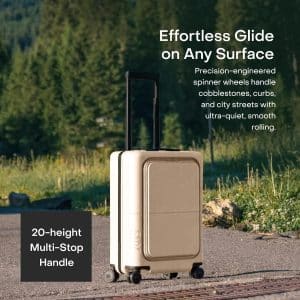
At first glance, the July Carry-On Pro looks like another minimalist hard-shell carry-on. The design feels clean, modern, and understated. In practice, its biggest differentiator sits on the front of the case.
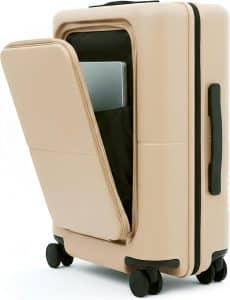
July built the Carry-On Pro around a dedicated front compartment designed for laptops, tablets, passports, chargers, and travel documents. That matters because frequent travelers constantly need access to electronics during airport security, boarding, and in-flight work sessions.
Many hard-shell carry-ons force users to unzip the entire suitcase to reach a laptop. The July Carry-On Pro solves that issue with a structured front compartment that stays separated from the main packing area. The setup feels far more practical during business travel or short work trips.
The suitcase also includes an ejectable battery system with USB-C charging support. Unlike permanently integrated batteries that can cause airline issues, July designed the battery to remove easily before flights. That small detail matters more than it sounds. Many airlines now require removable power banks in carry-on luggage.
This combination of quick-access organization and removable charging support gives the July Carry-On Pro a more business-oriented identity than many lifestyle-focused luggage brands.
Design and Build Quality
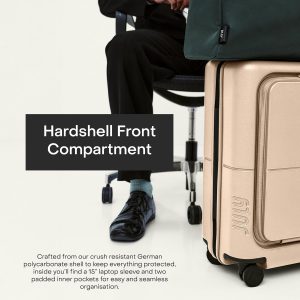
The July Carry-On Pro uses aerospace-grade German polycarbonate for its shell construction. That sounds like marketing language until you actually understand why it matters.
Polycarbonate offers a balance between durability, flexibility, and weight. Aluminum luggage feels premium but dents easily and becomes heavy fast. Cheap ABS plastic cracks more easily under impact. German polycarbonate sits in the middle, offering strong impact resistance while keeping the suitcase relatively lightweight.
July also shapes the shell with rounded edges rather than aggressive flat panels. Rounded structures distribute force more evenly during drops and impacts. As a result, the case handles rough baggage handling better over time.
The overall finish feels premium without becoming flashy. Matte color options help hide scratches better than glossy shells. The minimalist branding also works well in professional settings. You could roll this into a client meeting, airport lounge, or hotel lobby without it feeling overly trendy.
Where this gets interesting is wheel performance.
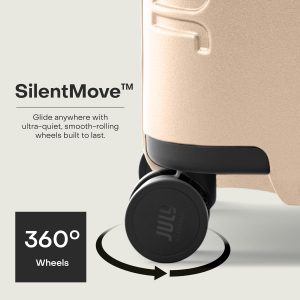
July designed its own SilentMove 360-degree spinner wheels instead of using generic third-party hardware. Most luggage companies barely discuss wheel quality, even though wheels determine much of the travel experience.
The July Carry-On Pro glides exceptionally smoothly across airport tile, concrete sidewalks, and rough pavement. Reviews consistently highlight how quiet the wheels feel compared to traditional spinner luggage.
That sounds minor until you drag luggage through a crowded airport at 6 a.m.
The telescopic handle also deserves attention. July uses a multi-stop adjustable handle rather than basic two-position systems. Taller travelers especially benefit because they can fine-tune handle height more comfortably.
 Smart Features That Actually Matter
Many premium suitcases now advertise “smart” features that feel unnecessary after the novelty fades. The July Carry-On Pro avoids most of those gimmicks.
The ejectable battery remains the most practical technology addition. It supports USB and USB-C charging, allowing travelers to top off phones, tablets, wireless earbuds, or even lightweight laptops while waiting at gates.
In practice, this feature works best during delays and long layovers. Airport outlets remain surprisingly difficult to access in busy terminals. Having integrated charging reduces that stress significantly.
The front laptop compartment also improves workflow during travel days. The compartment fits laptops up to 15 or 16 inches depending on the model. Padded internal pockets help separate accessories and smaller devices.
For consultants, remote workers, sales professionals, or creators, this layout feels noticeably more efficient than standard carry-on designs.
July also includes thoughtful secondary details:
- Integrated TSA-approved lock
- YKK Japanese zippers
- Hidden laundry bag
- Compression strap system
- Stain-resistant interior lining
- Water-resistant interior materials
None of these features alone justify the price. Together, they create a more polished travel experience.
The hidden laundry bag especially stands out during multi-day trips. Separating worn clothing without carrying an extra bag keeps the interior organized longer.
 Real-World Travel Performance
The best luggage disappears during travel. It should not create friction, instability, or constant adjustments.
This is where the July Carry-On Pro performs extremely well.
The suitcase weighs around 8.2 to 8.6 pounds empty depending on configuration. That is not ultralight, but it remains reasonable considering the structured front compartment and battery system.
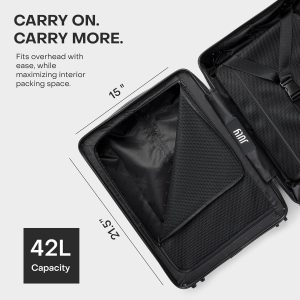
The dimensions generally comply with most major airline carry-on standards at roughly 21.5 x 15 x 8.5 inches.
For domestic travel, that size works comfortably overhead on major carriers. International travelers should still verify restrictions carefully because some stricter European airlines use tighter depth requirements.
The wheel system transforms how the luggage feels during movement. The suitcase tracks smoothly with minimal wobble, even when fully packed. Many cheaper spinner suitcases become unstable when turning quickly or crossing uneven surfaces.
The July Carry-On Pro maintains balance well.
That matters because airport travel involves constant directional changes, escalators, security checkpoints, and crowded walkways. Stability becomes surprisingly important during frequent trips.
The front compartment also improves airport efficiency dramatically.
Instead of opening the main compartment at security, travelers can remove laptops and tablets within seconds. During boarding, passports, chargers, headphones, and travel documents stay accessible without unpacking clothing.
Business travelers will appreciate this more than occasional vacation users.
 Organization and Packing Experience
The July Carry-On Pro offers roughly 42 liters of capacity. That translates to approximately five to seven days of travel depending on clothing type and packing style.
The compression system helps maximize available space effectively. July uses a Y-strap setup rather than simple elastic cross straps. The heavier-duty system compresses clothing more evenly and keeps items from shifting during transit.
The split-compartment interior also keeps organization manageable.
One side works well for folded clothing and shoes. The other side handles smaller garments, tech accessories, and toiletries more securely. Mesh zip sections improve visibility without creating bulky dividers.
In practice, the suitcase works especially well for:
- Short business trips
- Hybrid work travel
- Weekend city travel
- Creator gear transport
- Conference travel
- One-week minimalist trips
The front compartment changes packing strategy entirely.
You no longer need a separate laptop backpack unless you carry extensive camera gear or multiple large devices. For many travelers, that simplifies movement through airports considerably.
That said, overpacking the front compartment can affect weight balance slightly. Heavy laptops plus chargers plus tablets may create front-heavy handling if the main compartment remains lightly packed.
 How the July Carry-On Pro Compares
The premium luggage category has become crowded over the last several years. The July Carry-On Pro competes directly with brands like Away, Monos, and Horizn Studios.
Compared with the Away Bigger Carry-On, the July Carry-On Pro feels more business-oriented. Away emphasizes clean aesthetics and general travel usability. July focuses more heavily on accessibility and work-ready functionality.
The Monos Carry-On Pro offers similar front-pocket convenience, but July’s wheel system feels smoother and quieter in real-world movement. Monos often wins on color refinement and interior aesthetics, while July feels more engineered around workflow efficiency.
Horizn Studios also competes aggressively in the smart luggage space with removable charging systems and premium construction. However, Horizn products often cost significantly more depending on configuration.
Price-wise, the July Carry-On Pro usually lands around the mid-$300 range depending on customization and sales.
That places it firmly in premium territory.
The key question becomes whether the front-access design and refined mobility justify the price increase over traditional carry-ons.
For occasional leisure travelers, maybe not.
For frequent flyers, remote professionals, consultants, and creators, the convenience difference becomes much easier to justify.
 Things to Consider Before Buying
The July Carry-On Pro does many things well, but buyers should understand its trade-offs.
First, this is not the lightest carry-on available. Ultralight travelers may prefer simpler designs without structured front compartments or integrated charging systems.
Second, premium luggage pricing always reaches a point of diminishing returns. The July Carry-On Pro absolutely feels better than budget luggage, but it will not magically change travel itself.
The front pocket also reduces internal flexibility slightly. Travelers carrying bulky winter clothing or unusually shaped items may prefer a traditional open-shell design.
At the same time, the structured organization benefits most users carrying laptops, tablets, and smaller travel essentials.
Another consideration involves airline compatibility. While the dimensions fit most major carriers, some ultra-budget international airlines use stricter depth requirements. Travelers flying budget European carriers frequently should double-check measurements carefully.
Finally, hard-shell luggage always shows cosmetic wear over time. Matte finishes reduce visible scratching, but no polycarbonate shell stays pristine forever.
Final Verdict
The July Carry-On Pro succeeds because it improves practical travel problems rather than chasing gimmicks.
The front-access compartment genuinely makes airport movement easier. The removable battery system feels useful instead of excessive. The wheels perform exceptionally well. The materials feel durable and refined. Most importantly, the entire experience feels intentionally designed around modern travelers who carry technology everywhere.
This suitcase will not make sense for everyone. Casual vacation travelers can spend far less and still travel comfortably.
But for professionals, frequent flyers, creators, consultants, and hybrid workers, the July Carry-On Pro delivers a noticeably more efficient travel experience. That convenience becomes more valuable with every trip.
In a crowded premium luggage market, that practicality helps the July Carry-On Pro stand out.
Affiliate Disclosure
GadgetGram may earn a small commission if you purchase through links on this page. This helps support our independent testing and editorial work. We only recommend products we’ve researched or tested ourselves, and our opinions remain unbiased regardless of affiliate relationships.