SparkSchool AI Can Read Handwritten Homework—and Help Teachers Grade It
Paper homework isn’t disappearing from classrooms anytime soon. But SparkSchool AI is trying to make the stack waiting to be graded a little easier to manage.
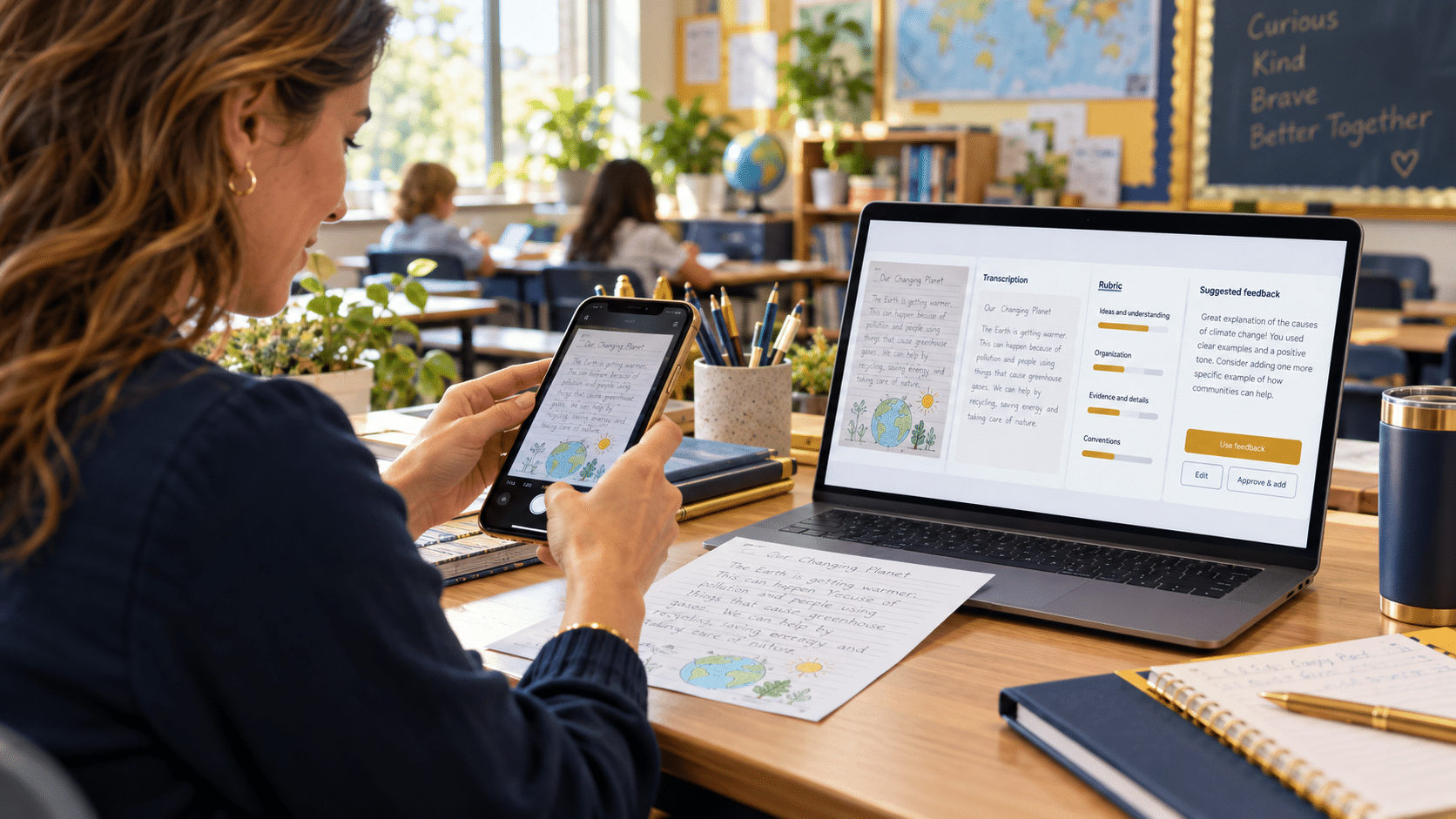
SparkSchool’s new handwritten homework review feature lets teachers upload scanned student work—or lets students simply photograph their completed homework. The platform uses OCR to read the handwriting before AI reviews the assignment against the teacher’s instructions and rubric.
The important distinction: the AI suggests the grade. The teacher makes the final decision.
Take a Photo and Let AI Make the First Pass
Students can photograph worksheets or notebook pages and submit them through SparkSchool. Teachers who collect physical assignments can upload photographs or scans themselves.
SparkSchool’s OCR transcribes the student’s handwriting while attempting to preserve the original line and paragraph structure. If it encounters handwriting it can’t confidently understand, the system marks the section [illegible] rather than simply guessing. (sparkschool.ai)
Once the handwriting is digitized, SparkSchool can compare the student’s work against the assignment and teacher-provided rubric.
The AI prepares a first-pass review that can include suggested marks, identified strengths, areas for improvement and draft feedback for the student.
The Teacher Still Assigns the Grade
This isn’t intended to be an autonomous AI grading system.
Teachers can examine SparkSchool’s transcription alongside the student’s original work, review the suggested score, change the marks and rewrite the feedback.
Only the score ultimately submitted by the teacher is recorded. (sparkschool.ai)
That’s an important distinction.
The potential time savings come from giving teachers a starting point. Instead of beginning every paper with a blank grading screen, the teacher gets a preliminary review to approve, correct or reject.
How much time that actually saves will depend heavily on handwriting quality, assignment type and the accuracy of the AI. Because the handwritten-homework functionality is new, we’d also like to see more independent classroom testing before drawing conclusions about its accuracy.
No Document Scanner Required
SparkSchool is particularly interesting alongside the sheet-fed scanner + Gradescope AI grading station we’ve been exploring.
Gradescope makes a compelling case for teachers who collect a stack of physical papers and want to digitize them efficiently.
SparkSchool offers another possibility: let the student’s phone become the scanner.
Students can photograph completed paper assignments and upload them directly. A teacher can still scan an entire class’s work when that’s more appropriate, but dedicated scanning hardware isn’t required.
That makes AI-assisted grading considerably easier to experiment with.
What About Student Privacy?
Any AI platform handling student assignments deserves additional scrutiny.
SparkSchool says homework submissions are privately accessible to the student and teacher and that prompts and generated content aren’t used to train its own models or third-party foundation models. (sparkschool.ai)
Its privacy policy also explains that information required for AI functionality may be processed using third-party AI infrastructure or model providers. Schools should therefore evaluate SparkSchool against their own student-data and AI policies before uploading identifiable student work. (sparkschool.ai)
That’s also an important difference from Grout, whose local AI grading workflow can process scanned student papers directly on the teacher’s computer.
GadgetGram Takeaway
SparkSchool’s most compelling idea isn’t that AI can grade homework.
It’s that paper homework doesn’t have to become digital homework for teachers to benefit from AI.
Students can continue solving equations, writing responses and completing worksheets by hand. Once the work is finished, a photo can turn that paper into something the AI can review against the teacher’s rubric.
The teacher still checks the student’s work, corrects the AI when necessary and determines the final grade.
For teachers staring at another stack of handwritten homework, that’s a much more practical vision for classroom AI: let the technology handle some of the first-pass work while keeping the teacher in charge.