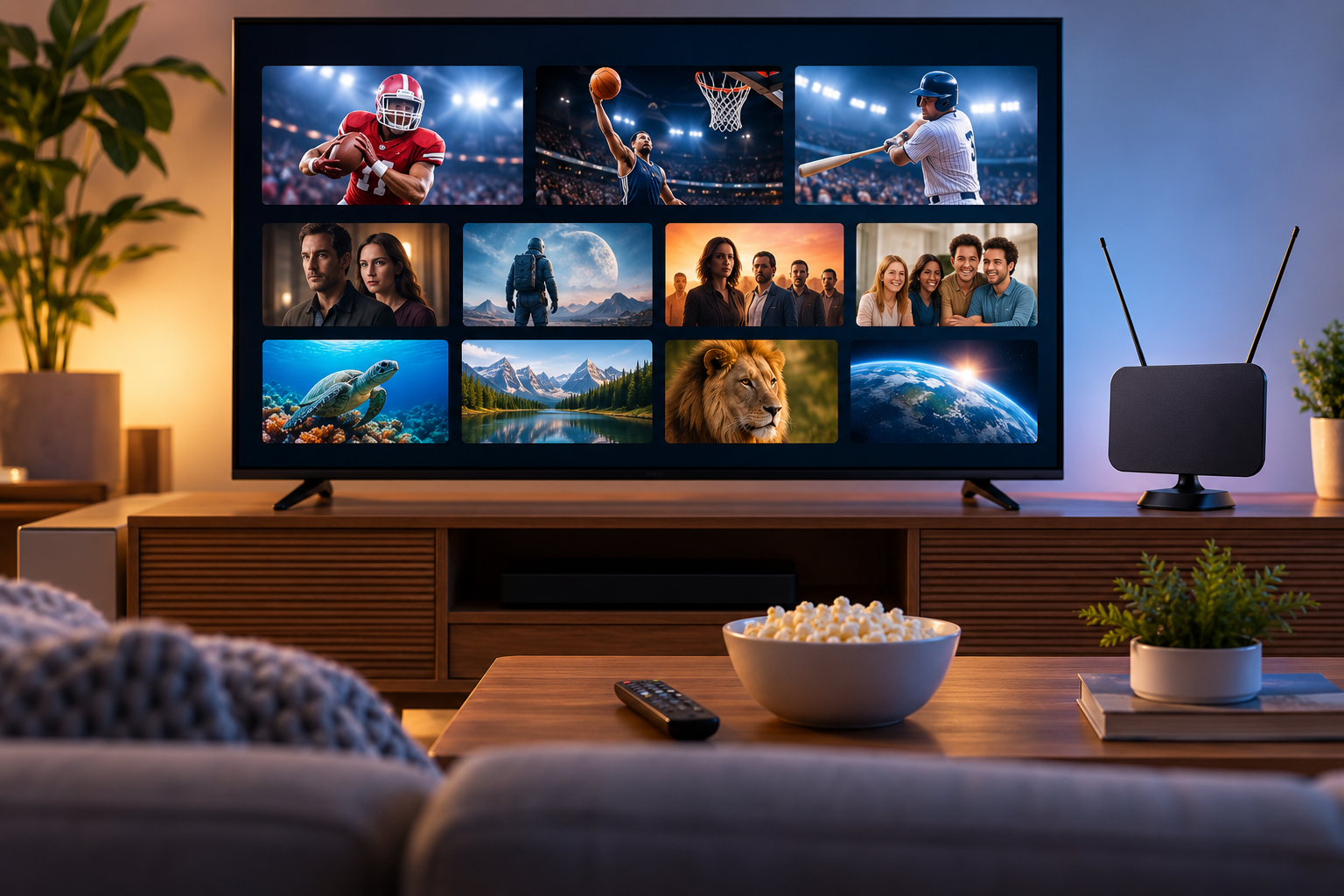
TV viewers now face a strange choice. Cable and satellite packages keep losing their grip, yet replacing them can require five or six streaming subscriptions. The good news is that cord cutters do not need every service.
The smarter approach combines free over-the-air TV with a few carefully chosen apps. For many households, the best streaming services for cord cutters depend less on which app has the biggest library and more on what the family actually watches.
Sports make that decision harder. NFL, NBA, MLB, NHL, and college games now stretch across broadcast networks and streaming services. Amazon, Apple, ESPN, Peacock, Paramount+, HBO Max, YouTube TV, and Fubo all hold important pieces.
Streaming now accounts for a huge part of American TV viewing. Nielsen reported that streaming reached 48.6% of total TV use in May 2026. Prime Video alone reached a platform record of 4.5%, helped by live sports and entertainment programming. Nielsen
That shift makes the old cable bundle less essential, but it also creates a new problem: fragmentation.
Here is how the major options stack up for different viewers.
Sports Fans: No Single Service Wins Everything
Sports fans face the most complicated streaming landscape.
An OTA antenna remains surprisingly valuable because ABC, CBS, FOX, and NBC still carry major games. Pair those free local channels with streaming and viewers can cover far more sports without paying for a traditional cable package.
For serious sports households, ESPN Unlimited deserves a close look. It includes ESPN, ESPN2, ESPNU, SEC Network, ACC Network, ESPN+, NFL Network, and other ESPN programming. Its coverage stretches across the NFL, NBA, NHL, MLB, college football, college basketball, tennis, golf, and more. ESPN Support
Fubo takes a different approach. It tries to recreate the sports-heavy cable bundle online. Its plans can include local ABC, CBS, FOX, and NBC stations, ESPN programming, and regional NBA, MLB, and NHL coverage, depending on the market. Fubo also launched new local sports options in September 2026. Fubo Investor Relations
NFL fans have another major consideration: YouTube. NFL Sunday Ticket remains available through YouTube and YouTube TV for out-of-market Sunday afternoon games. YouTube TV
Then there is Amazon.
Prime Video now carries 17 NFL games in its 2026 lineup, including Thursday Night Football, holiday games, and a Wild Card game. Amazon also offers a major NBA package. Prime Video will stream 67 NBA regular-season and NBA Cup games during the 2026-27 season. Amazon’s broader sports portfolio includes WNBA and NASCAR coverage. Amazon Ads
That makes Prime increasingly difficult for sports fans to ignore.
Sitcom and Drama Fans: Libraries Matter More
People who mostly watch scripted entertainment should approach the best streaming services for cord cutters differently.
Prime Video offers a broad mix of licensed shows and Amazon originals. Its lineup includes series such as Reacher, Fallout, The Boys, and The Summer I Turned Pretty. Amazon also owns MGM, which gives the company another large source of movies and television programming. Amazon News
Hulu remains important for viewers who want a large television-focused library, while Disney’s larger streaming ecosystem creates an attractive option for households that mix general entertainment with family programming and ESPN sports.
HBO Max makes more sense for viewers who place a high value on premium dramas, films, and HBO programming. It has also expanded beyond entertainment. Its 2026 sports lineup includes selected MLB and NHL games, NCAA March Madness, college sports, U.S. soccer, NASCAR, and other events. HBO Max
Paramount+ offers another interesting mix. Subscribers get a large movie and TV library while sports fans can access NFL on CBS, UEFA soccer, college football, UFC, and other events. Paramount+
There is no reason every household needs all of them. Rotating subscriptions as favorite shows return can cut the annual bill substantially.
Movie Fans: Prime Becomes More Interesting
Movie fans have even more flexibility because films move between services.
Amazon has strengthened Prime Video through Amazon MGM Studios while also turning the Prime Video app into a storefront for outside services. Viewers can subscribe to services including HBO Max, Paramount+, Peacock, Apple TV, MGM+, and others through Prime Video Channels. Amazon also offers hundreds of free ad-supported channels. Amazon News
That does not mean Prime always has the movie you want included with membership. Some titles require a rental, purchase, or another subscription.
However, that distinction creates an overlooked advantage.
Prime Video can function as a hub rather than simply another streaming library. A household can use Prime as its foundation, add another service when needed, and cancel that extra subscription later.
For people who already pay for Amazon Prime, that can make Prime one of the best streaming services for cord cutters from a total-value perspective.
Documentary and Educational Viewers
Documentary fans should focus less on one permanent subscription.
Prime Video, Netflix, HBO Max, Disney+, Hulu, Paramount+, and specialized services all offer documentaries, but their catalogs change. Sports documentaries add another layer because ESPN and several league partners produce their own programming.
A rotating strategy works especially well here.
Subscribe for a month or two, watch the documentaries and series you want, then switch. Unlike cable contracts of the past, streaming makes this kind of rotation practical.
Prime also offers an advantage because its broader ecosystem reaches beyond television into Audible, Amazon Music, Wondery podcasts, and other media properties. Amazon News
Apple TV Has Become a Sports Wild Card
Apple deserves special attention.
Apple TV now includes every MLS match for subscribers with no separate MLS Season Pass. Apple also carries Friday Night Baseball and became the exclusive U.S. home of Formula 1 coverage for 2026. Apple
That combination makes Apple TV especially relevant for soccer and Formula 1 fans.
It also illustrates where television appears headed. Instead of buying one huge cable package, viewers increasingly assemble their own package around specific leagues, shows, and services.
Why OTA TV Still Matters
Streaming’s growth does not make an antenna obsolete.
Quite the opposite.
An antenna can deliver local ABC, CBS, FOX, NBC, PBS, and other stations where reception allows. That gives households access to local news, major network programming, and many nationally televised sporting events without another monthly bill.
The combination can reduce one of streaming’s biggest weaknesses: paying a large monthly fee just to regain local channels.
The best streaming services for cord cutters therefore may work best alongside OTA television rather than replacing it.
Where Amazon Prime Fits
Amazon Prime does not replace ESPN, Sunday Ticket, local broadcast television, or every regional sports network.
That limitation matters.
But Prime has something most competitors lack. Consumers do not buy Prime only for television.
A standard U.S. Prime membership costs $14.99 per month or $139 per year. That membership includes Prime Video along with Amazon’s broader Prime benefits. Amazon News
For an existing Prime shopper, the effective decision looks different from subscribing to a standalone entertainment service.
Prime Video already provides movies, original series, NFL games, NBA games, WNBA coverage, NASCAR events, rentals, purchases, Channels subscriptions, and free ad-supported programming. Prime membership then adds benefits outside the television.
That makes Prime particularly compelling as the starting point of a cord-cutting setup, even though sports fans will still need other services.
Four Viewer Profiles to Consider
The serious sports fan: Start with an OTA antenna, then examine ESPN Unlimited, Fubo, or YouTube TV based on the teams and leagues you follow. Add Prime for its exclusive NFL and NBA games. NFL Sunday Ticket becomes important for fans who need out-of-market Sunday games.
The movies and series household: Prime offers a strong foundation because it combines entertainment with broader membership benefits. Rotate Hulu, HBO Max, Paramount+, Peacock, Netflix, or Apple TV when exclusive shows justify the expense.
The budget cord cutter: Start with OTA television and free ad-supported streaming. Add one paid service at a time. Prime makes more financial sense if the household already uses its shopping benefits.
The all-around household: An antenna plus Prime and one rotating secondary service may offer the best balance between cost and variety. Sports seasons can determine which secondary service comes next.
The New TV Bundle Is One You Build Yourself
Cable solved one problem by putting almost everything in one package. Streaming solved another by giving consumers more control.
Now those two ideas are colliding.
Sports fragmentation can push streaming costs surprisingly close to cable prices when viewers subscribe to everything at once. The solution is not necessarily another giant bundle.
It is choosing fewer services.
For many households, Prime deserves a place near the center because it now combines meaningful live sports, movies, series, and a much larger membership ecosystem. It cannot cover every game or every show, but few competitors provide value outside the television screen.
The best streaming services for cord cutters will therefore differ by household. An antenna can handle free local broadcasts. Prime can serve as a broad entertainment base. Then viewers can add ESPN, Peacock, Paramount+, Apple TV, Fubo, YouTube TV, or another service only when its exclusive programming earns the monthly fee.
That may be the biggest advantage cord cutting still offers: you get to build the bundle instead of letting the cable company build it for you.
External authority: Nielsen’s 2026 TV viewing data